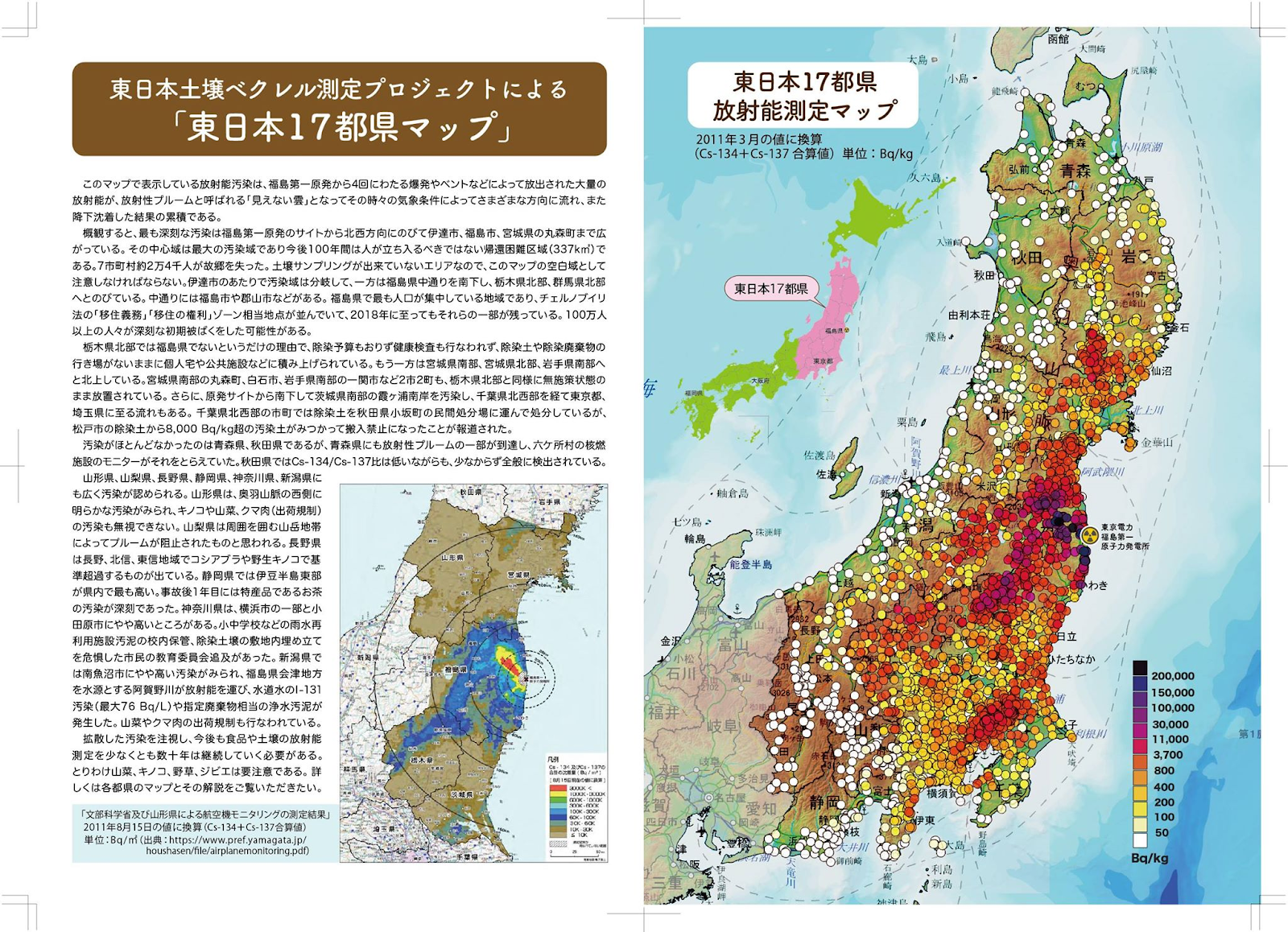
200 pages of fullcolor mapbook in Japanese is available on Amazon.
You can get it here;
https://www.amazon.co.jp/%E5%9B%B3%E8%AA%AC%E3%83%BB17%E9%83%BD%E7%9C%8C%E6%94%BE%E5%B0%84%E8%83%BD%E6%B8%AC%E5%AE%9A%E3%83%9E%E3%83%83%E3%83%97-%E8%AA%AD%E3%81%BF%E8%A7%A3%E3%81%8D%E9%9B%86-2011%E5%B9%B4%E3%81%AE%E3%81%82%E3%81%AE%E6%99%82%E3%83%BB%E3%81%84%E3%81%BE%E3%83%BB%E6%9C%AA%E6%9D%A5%E3%82%92%E7%9F%A5%E3%82%8B-%E3%81%BF%E3%82%93%E3%81%AA%E3%81%AE%E3%83%87%E3%83%BC%E3%82%BF%E3%82%B5%E3%82%A4%E3%83%88%E3%83%9E%E3%83%83%E3%83%97%E9%9B%86%E7%B7%A8%E9%9B%86%E3%83%81%E3%83%BC%E3%83%A0/dp/4991042704/ref=sr_1_1?s=books&ie=UTF8&qid=1547987858&sr=1-1
We are trying to publish digest in English near future.
If you feel that the English version would be necessary, please cheer us!!
2019年1月20日日曜日
2019年1月12日土曜日
200pages map-book has released now!
We published the map book in Japanese.
Japanese government has done little research on radioactive soil outside of Fukushima, despite the radioactive contamination has spread very widely not only inside Fukushima, but through east Japan.
This is the only book to know whole contamination through 17 east Japan about Soil and Food.
This is whole records written by citizen radioactive measurement network in Japan, called "Minna no Datasite"( everyone's Datasite).
Japanese government has done little research on radioactive soil outside of Fukushima, despite the radioactive contamination has spread very widely not only inside Fukushima, but through east Japan.
So, the citizen stood up, actually collected and measured 3400 soils in 17 prefectures, and revealed the actual condition of radiation for 3 years and recorded them into one database system to show the digital map.
This book contains these map in 17 prefectures, and, commentary.
Trends in food radioactivity, basic knowledge of radioactivity are also included.
That means this book contains everything people wants to know.
The title is "Illustration 17 prefectures radiation measurement map plus commentary".
A4 size full-color 200pages (in Japanese)
The title is "Illustration 17 prefectures radiation measurement map plus commentary".
A4 size full-color 200pages (in Japanese)
1 printing 3,000 copies released in November 13.
2 printing 3,000 copies released in December 21.
3 printing 5,000 copies will be released in January 18.
Front page
2018年9月19日水曜日
[Posted] September 19, 2018 published in the Tokyo newspaper "here Nuclear Interview Team"
On September 19, 2018, the Tokyo Newspaper introduced our publishing activities and calls for financing.
The article titled "Crowdfunding in progress for Publishing radioactive contamination investigated by 4,000 citizens."
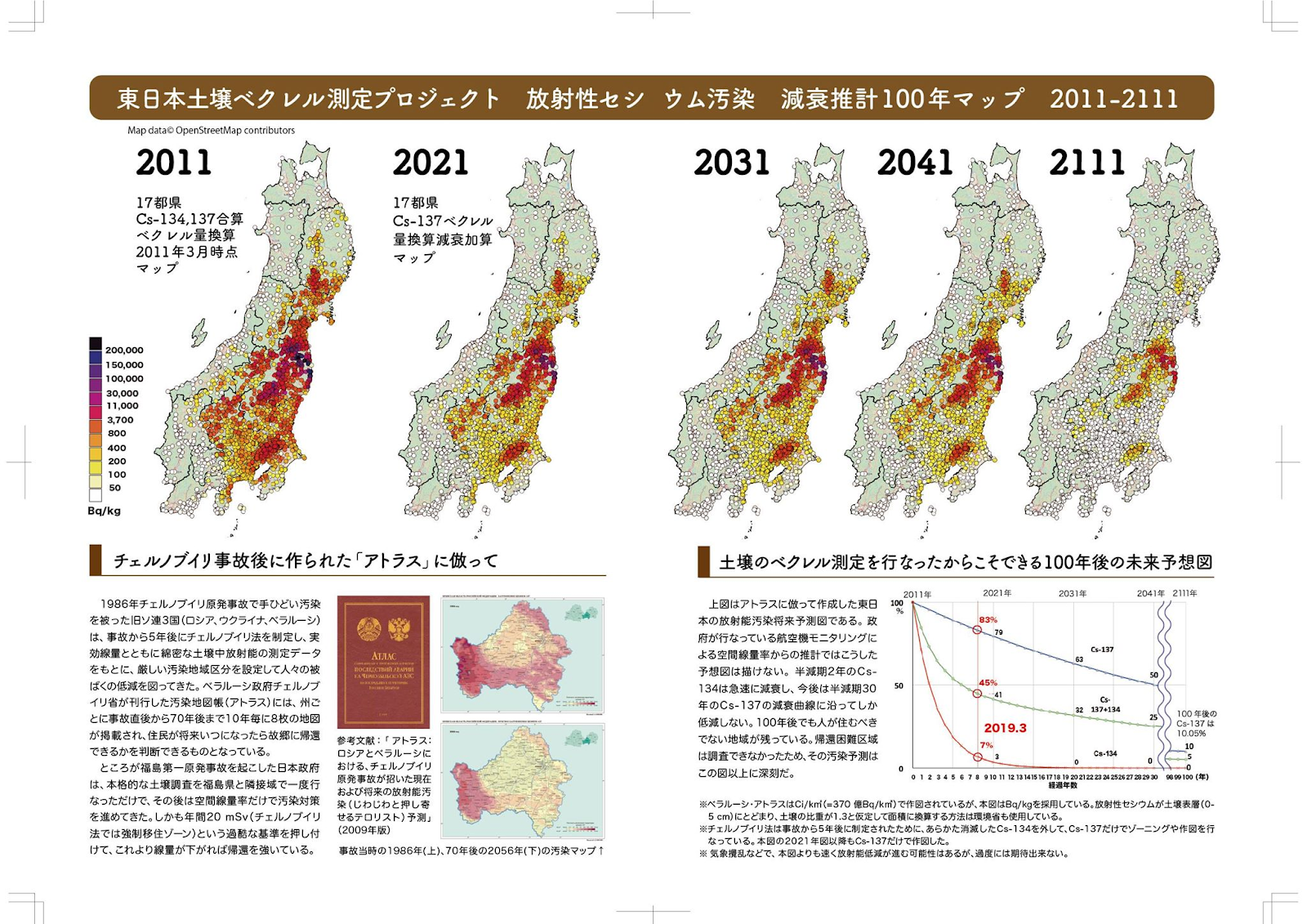
We shows maps 100 years after Fukushima Nuclear Power Plant accident, that estimated how the cesium 137 in various places of eastern Japan in 2111. We also analyzed and refers to the relationship between soil cesium contamination and food contamination in this book.
It will be 170pages full color A4size.
Currently it will be published in Japanese.
If you would like to make a donation, please send it to the following account
The article titled "Crowdfunding in progress for Publishing radioactive contamination investigated by 4,000 citizens."
We shows maps 100 years after Fukushima Nuclear Power Plant accident, that estimated how the cesium 137 in various places of eastern Japan in 2111. We also analyzed and refers to the relationship between soil cesium contamination and food contamination in this book.
It will be 170pages full color A4size.
Currently it will be published in Japanese.
If you would like to make a donation, please send it to the following account
◎Donate by the bank transfer
Postal Transfer:
Postal Transfer Account : 10090-85754261
Account Name: Minna no data site Unei Iinkai
Postal Transfer Account : 10090-85754261
Account Name: Minna no data site Unei Iinkai
Bank Account
Yuucho Bank Branch : Zero Zero Eight (Branch 008):
Interim : 8575426
Account Name: Minna no data site Unei Iinkai
Yuucho Bank Branch : Zero Zero Eight (Branch 008):
Interim : 8575426
Account Name: Minna no data site Unei Iinkai
Remittances in either USD or EUR can be made from overseas banks,.
Please note that remittances to Japan cannot be made from certain financial institutions.
For details, please ask your local bank.
Please note that remittances to Japan cannot be made from certain financial institutions.
For details, please ask your local bank.
The donation will be spent carefully for maintaining this project, such as server maintenance, site maintenance and development, activities, printing and staff cost.
Thank you for your support in advance.
2017年12月31日日曜日
Speech presented for Hizumi Award
On December 15, 2017, we awarded the Hizumi Prize.
Here is our speech on that day.
Speech by Hidetake Ishimaru
My name is Hidetake Ishimaru and I'm one of the representatives of Minna no Data Site. I'm greatly honored and thankful that we have received the Grand Prize of the 2017 Kazuo Hizumi Promotion of Information Distribution Award out of all the many outstanding activities.
Minna no Data Site is a network type organization consisting presently of 34 citizen’s radiation measurement labs all over Japan. The accident at TEPCO’s Fukushima Daiichi Nuclear Plant in 2011 drove people to open these labs and start their activities and they spread from Hokkaido up north to Kyushu down south.
We started up Minna no Data Site in September of 2013. Our objective was to gather the radiation measurement data that each lab had accumulated onto the same platform and to provide people with accurate and easy to understand information. Presently, we have registered about 14,000 measured data of food and more than 3,400 measured data of soil samples. Further, this fall, we started a site where you can search and find data for environmental samples, such as ashes and mulch. I would be happy if you look up our site and see for yourselves.
Talking about the standard value for food, at first, the government set the provisional standard as 500Bq per kg and afterwards lower it down to 100Bg/kg. However, there is a cause for concern because the figure is questionable. Even before the accident, the standard value for low-level radioactive wastes, which should be kept in an yellow oil can, was 100Bg, the same as food. This is the present situation. The many citizens that are living in this unfortunate reality with great concern for their children requested for the radiation measurement data. The datum was gathered and registered here and became a very precious and the only source that people could refer to. One cannot find such information elsewhere and since we started it up, people are using it as one of their references in their daily lives. For example, if you have difficulty deciding what is safe to buy at a supermarket, just look it up with your smart phone, etc.
As you see, Minna no Data Site started out by visualizing the data on food, but we recognized the significance of visualizing the contamination of soil as well, and thus, we launched the “East Japan Soil Becquerel Measurement Project” in the fall of 2014. (4 : projection of soil map) Allow me to briefly explain to you about the “soil project” since it was through the recognition of this project that we received this award.
The “soil project” was executed throughout a vast range of sample collecting area covering 17 prefectures and city of east Japan, from Aomori up north to Nagano and Shizuoka down south. The same method was used to collect soil samples at every collection site and the radiation was measured by becquerel.
We started this project by measuring and mapping the average contamination rate of each area as accurately as possible, by eliminating the micro hot spots where the contamination is extremely high and the places that already have been decontaminated or cleaned with low contamination. We conducted our measurement at the height of 5cm above ground so that the results could be compared with the measurements by the Ministry of Education and those by Chernobyl.
In order to maintain the same method of collecting soil, we made a cartoon style manual and held over 100 seminars throughout the area giving instructions on the methods of collection. Cumulative total number of collection volunteers were over 4000 in the 3 years and over 3400 soil samples were collected and measured and mapped.
In the Ukraine and Belarus, national budget was spent respectively for mapping the soil contamination nationwide, where as in Japan, a thorough soil measurement of the whole east Japan area has not yet been conducted by the government, only estimation derived from the air dose radiation rate measured by screening taken from airplanes. “If the government won’t do it, why don’t we?” And so, the project started with almost no budget.
Before we actually started, many of us felt that it is unrealistic to conduct measurement of such vast area as the whole of east Japan. However, just as many of us felt sure that we could get support from the citizens and that we owe it to them to start it up. We realized and accepted the fact that if the government is incapable or doing anything, who else but us with the biggest network of citizen’s measurement labs are best equipped to do it.
We faced a lot of difficulty until the soil sample collection and measurement went on orbit. At first, we had a blank map before us and little by little, the number of collected samples increased. Along with that, we needed to closely determine the objective number of samples, bearing in mind, the population, the size, and the air dosage rate of each area. We wanted to fill in the blank map of each prefecture and city as evenly as possible. The measurement site extended not only to urban areas, but also to remote rural areas and deep in the mountains. There were places that were very hard to get to by foot. We had a variety of volunteers, those who worked in groups, those who worked on their own and collected many samples, those who were willing to go on a forced march, etc. Each dot on this map is a fruit of all the effort of so many people.
So, as you can see, this map was created through very painstaking sample collection and distribution to measurement labs nationwide and also through laborious and time-consuming work of data input. I do not want to boast, but this map is extremely valuable and I can say with confidence that it is a fruit of an activity to share and distribute “unprejudiced information” by the power of the people, which is in truth the principle of this Hizumi Award. I am honored to receive this award to share with the 34 measurement labs and with the 4,000 people who collected the samples, and to everybody who supported us and helped us finance this activity. Please allow me to use this opportunity to express my gratitude towards them.
In the Ukraine and Belarus contaminated by highly concentrated radiation caused by the Chernobyl accident in 1986, national budget was spent respectively, for mapping the soil contamination nationwide.
The data obtained is utilized as a standard for determining the amount of compensation etc. in the Chernobyl Laws laid down after 5 years from the accident.
On the other hand, what has our government done? In March 2017, this year, after 6 years from the accident, the government has not only neglected to lay down laws to acknowledge those subject to compensation, but went on and forced the discontinuation of housing allowances. The Chernobyl Laws determined the area of compensation both by annual effective dose (Sv) and by soil contamination dose (Bq which at the start was Ci) but here in Japan, the annual dose of 20mSv, which is an outrageous amount, is the standard of tolerance dose. This is 20 times as much as the limit of public exposure dose and 4 times more than the annual 5mSv, the amount that individuals engaged in radiation work are eligible for recognition as having an occupational disease. It deprives people’s rights for compensation of evacuation, etc. and should be considered inhumane.
There are many factors to the contamination status and therefore it is not easy to make a comparison in general, but if we go by the Chernobyl Laws, the orange points on the map are areas that evacuation rights should be granted, and the red points are where evacuation is recommended. In Japan, because only a very high standard annual dose rate of 20mSv is set, there are no residential restrictions even in these contaminated areas. “Moving” or “recuperation” decisions were passed over as “done with self -responsibility” as the minister for reconstruction, Mr. Imamura put in his own words. We needed to conduct a thorough soil measurement and our continuous efforts were to provide a potential solution to this situation where people had to accept the ill-treatment of living in a contaminated area under the name of “self- responsibility.” Please refer to the comparison chart with the Chernobyl standard that we handed out.
Fortunately, the measurement results of food show that the transfer of contamination to crops and farm produce show tendency to be minimal, excluding the contamination caused right after the accident. This is due to the argillaceous characteristic of Japanese soil. On the other side, however, there are many cases where contaminations of wild mushrooms, wild vegetables, wild animals such as boar and fresh water fish rate high. The contamination of soil and the environment extends to widespread area of east Japan Also, the contaminated trees used as firewood and burnt producing ashes are continuous serious causes for concern.
The half-life period of Cs-134 is 2 years and relatively short. At present, it is reduced to 10 % of the original dosage right after the accident. On the other hand, the half-life period of Cs-137 is 30 years and it will be around for quite a long time to come.
You can see clearly in this map we have made that its amount will not completely attenuate even after several years. It is a type of radiation that cannot be seen, smelled of tasted, but we must not forget that the contamination exists and continue to take measures against it.
It is obvious that we need an outline or a framework to cope with this domestic nuclear-power related severe accident like the Chernobyl Laws laid down by the Ukraine, Chernobyl and Russia. Nevertheless, our country continues to emphasize the notion through new reports and presentations, that this accident is taken care of and that there are no more serious contamination influences.
We feel it is our responsibility to continue and reinforce our efforts to dispatch information of objective data so the “true reality” can be visualized by everybody. We aspire to continue our activities so that we can all learn from the 2011 accident and also be of service to the individuals who still suffer from the aftermath.
The reception of this award has truly given us so much strength. With such encouragement, we are ready to continue moving on forward.
I’d like to end my speech with a heartfelt “Thank you” from every one of us at Minna no Data Site. Thank you very much.
2017年11月17日金曜日
Winner of the Grand Prize for 2017 Kazuo Hizumi Promotion of Information Distribution Award
Kazuo Hizumi Promotion of Information Distribution Award was founded to recognize the efforts and throws light onto the media, journalists and private individuals engaged in the field of information communication whose activities are focused on the freedom of expression, the disclosure of information and people’s rights to know. The grand prize award for 2017 was decided to be awarded to Minna no Data Site Project. This project has been conducting measurements and accumulations of soil that have been contaminated by the effect of the accident at TEPCO’s Fukushima Daiichi Nuclear Power Station. It was recognized for the summarization and disclosure of scientific data accumulated from a wide-spread contaminated area of 17 prefectures and city in East Japan, in ways that were understand comprehensible to everybody.
The encouragement award was given to Mr.
Takashi Ozaki, a photographer who repeatedly gathered information about the members
of SEALDs (Students Emergency Action for Liberal Democracy.) The special award
went respectively, to Mr. Makoto Kimura, a city council member of the city of Toyonaka,
for his repeated disclosure of information pertaining to the Morimoto Gakuen
Scandal, and to Ms. Miyuki Ohara, who is the original proposer of “Kokkai
Ondoku” which is a means to read aloud the questions and answers in the Diet on
conspiracy that don’t quite bite evenly.
Recipients
Grand Prize Award : “Minna no Data Site activities
(co-representatives : Mr. Hidetake Ishimaru, Mr. Hiromi Abe, Ms. Shoko Onuma)
Encouragement Award : Information gathering
on SEALDs members (Mr. Takashi Ozaki)
Special Award : Investigation an information
disclosure pertaining to Morimoto Gakuen Scandal (Mr. Makoto Kimura)
Special Award : “Kokkai Ondoku” Activity (Ms.
Miyuki Ohara)
Awarding Ceremony
Date : Friday, December 15th
(18:30~)
Place : Hibiya Convention Hall
(1-4,
Hibiya Koen, Chiyoda-ku)
The Fifth Kazuo Hizumi Promotion of
Information Distribution Award : List of Recipients
Grand Prize Award ( given to 1 party, extra
prize 300,000 yen)
Activities of “Minna no Data
Site”(co-representative: Mr. Hidetake Ishimaru, Mr. Hiromi Abe, Ms. Shoko Ohnuma)
Reason for the Awarding
Minna no Data Site conducted a public
participation style project by involving the citizens to collect, measure and
accumulate the soil that are contaminated by radioactive substances caused by
the accident at TEPCO’s Fukushima Daiichi Nuclear Plant, and plotting the
result data on the map for easy comprehension. This project was chosen for the
intelligible disclosure of scientific data constantly standing on the people’s
side. The contamination data accumulated and disclosed were derived from soil
collected by the hands of the citizens that were widely called upon, from a
widespread area of 17 prefectures and city.
2017年1月17日火曜日
Report:A press conference at " The Foreign Correspondents’ Club of Japan"- January 17, 2017
On January 17, 2017, a press conference was held at " The Foreign Correspondents’ Club of Japan" organized by "3 + 1"(SAN TASU ICHI).
The purpose of the press conference on 17th January is to inform you of the severity and actual condition of compensation for evacuees of the Japanese government during the Fukushima Daiichi Nuclear Power Plant accident.
"Minna no Data Site" was present as an observer to explain the current situation of radioactive contamination in eastern Japan.
Presenters are Mr. Ishimaru Hidetake, secretary general of "Minna no Data Site" on the left, Mrs. Noriko Matsumoto on the center, Fukushima Daiichi Nuclear Incident evacuees, right is a journalist and Chia Yoshida, author of "Rupo Mother and Children Evacuation".
The following is the presentation material used by "Minna no Data Site" on the day.
In addition, the 8th to 10th slides are replaced with those updated after the press conference.
Note: "3 + 1" means that three people who shared the thought that this country would not surprisingly change anything despite East Japan great earthquake disaster of March 11, 2011 It is an action that expressed the thought of a film director.
We are planning screenings and events for each movie against many contradictions such as nuclear power plants, regional disparities, US military bases, poverty and discrimination.
http://3tasu1.com/
The following is an overview of "Minna no Data Site" distributed on the day.
The summary of East Japan soil measurement project by Minna No Data Site.
Commentator: Hidetake Ishimaru (Director of “Minna no Data Site: Combined database independent Radioactivity Measurement labs”)
<What is Minna no Data Site?>
After the accident at Fukushima Daiichi nuclear power station in March 2011, the level of radioactive contamination became severe. Thus many Independent Radioactivity Measurement Labs have started around Japan. “Minna no Data Site” is a combined database of those labs on the internet, which offers everyone an easy access to research on foods contamination level. It started in 2013. We started soil measuring project from 2014.
”Minna no Data Site” is the biggest association of Independent Radioactivity Measurement Labs. 32 labs are the member of the association. All of the labs have passed the measuring machine’s accuracy standard to join the database.
We are a non-profit organization. Our committee is made up of members from the Independent labs.We are independent from any political groups, or social groups.
We have about 14,000 data of foods, and about 2,800 data of soil from different areas.
We include unique data like processed foods that the government do not usually measure. You can research them by name, area, date and produced district.
<The significance of the soil project>
However, after the accident in Japan, the government has not done the measurement of soil unlike three of the countries. Ministry of Education has done radioactivity measurement monitoring from airplanes, and each municipality has been measuring the contamination in air (1m above from the land).
The parents are worried about if it is safe to let the children play outside, and if it is, they are wondering where the safe place is. There are people who want to know the current situation about radioactivity, wonders from people that essentially this should have been the government’s duty. After hearing all those opinions, we decided to measure the level of Becquerel in soil around 17 prefectures by ourselves. 4,000 people have offered us to help this project, and they sent us samples of the soil from their living area, and we measure those samples in our labs. In this 2 years and half, we have measured soil from 2,500 different places. It is very rare and valuable data.
It has been 5 years after the accident, and it seems as if nothing happened. While returning policy to the stricken area by the government are proceeding, we are trying to understand the accurate contamination level in soil in the wide area.
<The Methodology of sampling soil>
The sample soil are collected in the same way as Legal Regime of Chernobyl problem standard, thus we can compare the contaminated level in Fukushima with Chernobyl. We made clear about 2 points below to understand different tendency in all the areas of East Japan.
First, the depth of gathering the soil have to be the same. This is because cesium has tendency to be higher when it is closer to the surface and the level decrease as it goes deeper in the land.
Second, we do not include area which have become micro hot spot by concentration of cesium.
With all the conditions above, we collect more than 1ℓ of soil each, and record the data into a same format. For citizens without any experience of gathering soil, we created comic version of the manual. Thus those people can easily join our project.
Applicable place for gathering soil: soil which has been without removed of radiation, and dry.
Not applicable place for gathering soil:
1. Sandbox (because the sand is changed constantly)
2. Under the slopes (Ex: slopes at parks. they can be highly contaminated hotspot)
3. Around roots of trees
4. Moss
5. Under gutter or drain
6. Mud on the side of roads
Below is the items to fill in on the format
●date of gathering
●weather
●address
●latitude and longitude (only until 3 decimals to avoid specifying individual's house to protect privacy)
●types of land
●types of soil
●optional item: the name of the machine to measure radioactivity in the air
●optional item: radioactivity in the air
<About situation of contamination in East Japan>
Contamination in the 5cm soil in many areas are more than the Zone of Intensified Radio-Ecological Control from Legal Regime of the Chernobyl Problem.
Those tendency can be found in the South area in Iwate prefecture, South area in Miyagi prefecture, all areas in Fukushima prefecture, South and East areas in Gunma prefecture, South area in Ibaragi, North West area in Chiba prefecture, East area in Tokyo.
[*1] Results of caesium 137 is being calculated to match the current date (2017/1/17) from the measured date.
[*2] Each data has been converted into Bq/㎡ by the weight and volume of the sample.
[*3] Both soil project and Chernobyl have gathered the sample from depth of 5cm.
[*4] Each area’s results are the results from a particular point, so please think it as reference results.
[*5] We try to avoid hotspot or decontaminated area, however, there might be areas that applies to one of them.
[*6] It is not easy to compare the radioactive contamination between Japan and Chernobyl due to the difference of food culture, difference of the contamination that moved to the crops from the soil, difference of the level of strontium, and so on.
<Plans for the future>
Minna no Data Site’s “Measuring Becquerel in Soil in East Japan Project” with fee-free measurement will be finished in March 2017. We will continue to measure with some charges. From April to September we are going to make a map book (atlas version) with description for each 17 prefecture.
Beforehand, we are going to release internet version to make the information available to people earlier, while making those information into the book version. In those times, we are going to issue a press release, so we can continue to be interviewed.
We are going continue to offer data as a guideline for people to think about the society, protect children from radioactive contamination, and reducing being exposed to radiation.
2017年1月7日土曜日
Article: Tokyo newspaper issued by 2017/01/07
Investigation on soil:
A step away from completing 3000 samples of soil that has been contaminated by
the nuclear power station’s accident. Civilians measuring radiation in 17
prefectures in East Japan.
Citizens’
radiation measuring station collectively created website “Minna no Data Site”. It gathers results
of foods and soil samples’ radioactive contamination by TEPCO’s Fukushima
Daiichi nuclear power stations’ accident. The operators
of the website are now in the process of publishing a booklet of conclusion of
the soil project that they have been carrying out for 2 years. They have
measured more than 2,500 soil samples from 17 prefectures of North-East Japan
except for Hokkaido. They will complete the project after they measure 500 additional
samples.
Minna no
Data Site started in October, 2014. There are 33 citizens’ radiation measuring
stations around Japan. With the new map coming by the project, viewers can look
up areas, dates when the sample was measured and cesium contamination levels of
soil samples. On the website, they can also search more than 13,000 foods
samples depends on harvested and purchased areas, measured dates and cesium
contamination levels. They have covered the expenses of measuring and operation
of the organization by funding and donations.
One of the
committee members Kiyumi Oyama (52 years old) said “we are one step away from
reaching the goal of measuring 3000 soil samples”. They are lacking soil
samples especially from Kanagawa, Tochigi and Gunma prefectures. They need 500
more samples from those regions.
For this
project, they did crowdfunding campaign to raise ¥2,000,000 on the website
called “moonshot” until last January. “We would like to publish the booklet by
September” said Ms.Oyama. The booklet will include map that shows radioactive
contamination levels in soil as well as analysis by the operator of the
measurement.
The results
of food samples are going to take more time to be summarized since they will
compare it with the analysis of soil contamination situation. “We would like to
ask you to rend us a hand to our project that make the invisible radiation
visible” said Ms. Oyama. More details of the project can be found on the
website of “Minna no Data Site” or “moonshot”.
登録:
投稿 (Atom)